
Dark Matter Found? Fermi Telescope's Clue!
Alright, let’s talk dark matter . It’s the cosmic elephant in the room we know it’s there, influencing the rotation of galaxies and the structure of the universe, but we can’t directly see, touch, or taste it. It’s like that relative everyone talks about but never shows up to family gatherings. And now, after years of searching, scientists using the Fermi Gamma-ray Space Telescope may have finally sniffed out some direct evidence. This isn’t just another scientific paper; it could rewrite our understanding of, well, pretty much everything.
The Fermi Telescope’s Curious Findings

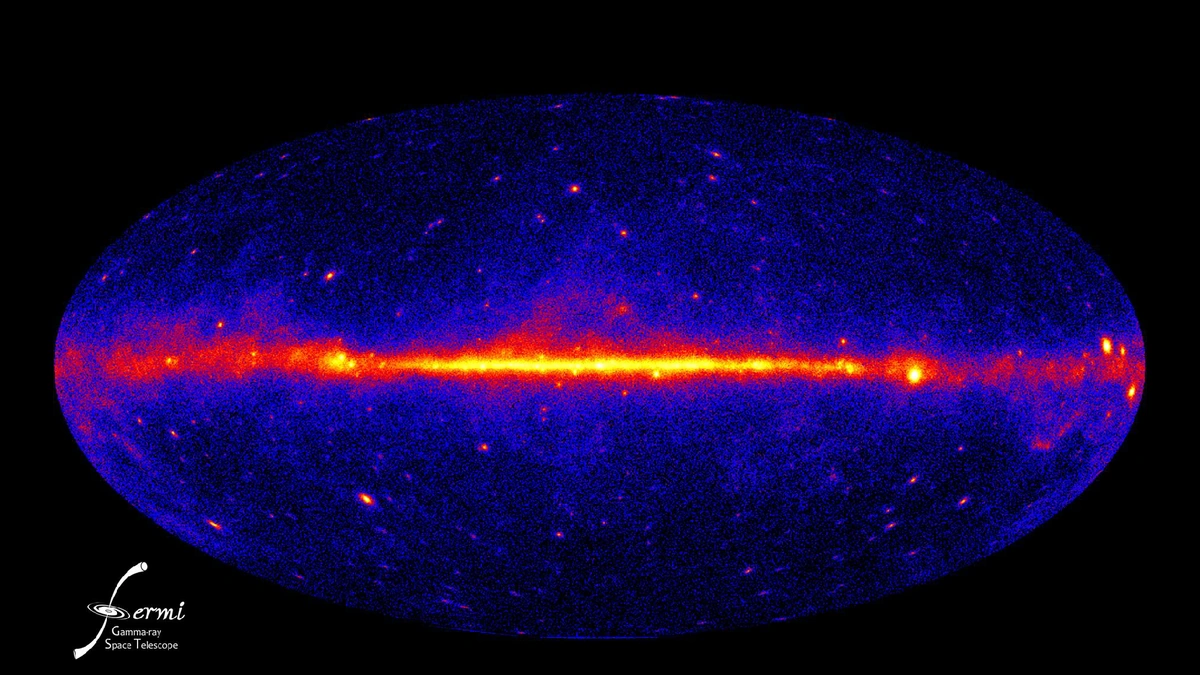
So, what exactly did the Fermi telescope see? The telescope, orbiting high above Earth, detects gamma rays, the most energetic form of light. Scientists have been analyzing years of data, looking for telltale signs of dark matter annihilation . The theory goes that if dark matter particles collide, they can annihilate each other, producing a burst of gamma rays. This is like matter meeting its anti-matter twin and going “poof”, creating a shower of energy.
What’s particularly interesting is that the excess of gamma rays detected by Fermi seems to be concentrated near the center of our galaxy, the Milky Way. Now, that’s what the scientists believe as potential first direct evidence of dark matter .
Here’s the thing: there are other potential explanations for this excess. It could be pulsars, rapidly rotating neutron stars that emit beams of radiation. Disentangling the dark matter signal from these more mundane sources is a huge challenge. But, what excites scientists, is that the signal matches many predictions of what dark matter annihilation would look like.
Why This Discovery Matters (and Why You Should Care)
Okay, so maybe you’re not an astrophysicist glued to the latest research papers. But here’s why this potential discovery should pique your interest. For starters, dark matter makes up about 85% of the matter in the universe. Let me rephrase that for clarity: everything we can see – planets, stars, galaxies, the chai you’re sipping – is just the tip of the iceberg. Dark matter is the massive, unseen scaffolding upon which the cosmos is built. Understanding it is fundamental to understanding the universe itself. It’s a puzzle, and we are slowly putting the pieces together.
But, it is not just about cosmic curiosity. Understanding dark matter could also have profound implications for our understanding of fundamental physics. It could reveal new particles and forces that operate at energy scales far beyond what we can currently probe in particle accelerators like the Large Hadron Collider. Who knows, maybe solving the dark matter mystery will pave the way for new technologies or even revolutionize our understanding of gravity.
And, let’s be honest, the quest to understand dark matter is just plain cool. It’s a reminder that there are still enormous mysteries out there, waiting to be solved. It’s the kind of thing that makes you look up at the night sky and wonder what’s really out there. The search for dark matter has led to the development of innovative detection techniques and instruments. These advancements in technology could have applications beyond astrophysics, benefiting fields such as medical imaging, materials science, and sensor technology.
The Challenges Ahead | Confirming the Signal
So, have scientists actually found dark matter ? The short answer is: not yet. The evidence from the Fermi telescope is intriguing, but it’s not definitive. There are still a number of hurdles to overcome.
One of the biggest challenges is ruling out other potential sources of the gamma-ray excess. Pulsars, as mentioned earlier, are a prime suspect. To confirm the dark matter signal, scientists need to develop better models of the distribution of pulsars in the Milky Way and figure out a way to distinguish their gamma-ray emissions from those of dark matter annihilation .
Another approach is to look for dark matter signals in other galaxies or even in our own solar system. There are a number of ongoing experiments designed to detect dark matter particles directly, using ultra-sensitive detectors buried deep underground. These experiments are looking for the faint recoil of dark matter particles as they collide with ordinary matter. It’s like trying to detect a mosquito hitting a truck a real challenge!
What fascinates me is the collaborative nature of this research. Scientists from all over the world are pooling their expertise and resources to tackle this problem. It’s a testament to the power of human curiosity and our collective desire to understand the universe.
Dark Matter and the Future of Cosmology
The search for dark matter is not just an academic exercise; it’s a fundamental quest to understand the nature of reality. If we can finally identify the particles that make up dark matter , it would be a monumental achievement, on par with discovering the electron or unlocking the structure of DNA. According to the latest circular on the official NASA website ( science.nasa.gov ).
Understanding dark matter could also help us to refine our models of the universe and its evolution. It could shed light on the formation of galaxies, the distribution of matter in the cosmos, and the ultimate fate of the universe. It could even help us to understand dark energy , another mysterious substance that makes up about 70% of the universe and is responsible for its accelerating expansion.
Let me rephrase that for clarity… the discovery of dark matter has the potential to change everything we know about the universe. It’s a truly exciting time to be a scientist (or just someone who’s curious about the cosmos).
But — and this is a big but — we need to be patient. Science is a process of trial and error, of careful observation and rigorous testing. It may take years, or even decades, to definitively solve the dark matter mystery. But the journey is well worth it. The rewards, in terms of knowledge and understanding, are immense. RMCL Universe .
The Indian Connection
India, too, is playing a vital role in the search for dark matter . Indian scientists are involved in various international collaborations, contributing their expertise in data analysis, theoretical modeling, and detector development. Institutions like the Tata Institute of Fundamental Research (TIFR) and the Indian Institute of Astrophysics (IIA) are at the forefront of dark matter research in India. Also, scientists work to study dark matter halo in the universe.
FAQ About Dark Matter
Frequently Asked Questions (FAQ)
What exactly is dark matter?
It’s a type of matter that doesn’t interact with light, making it invisible to telescopes. We infer its existence from its gravitational effects on visible matter.
How do scientists know it’s there if they can’t see it?
By observing the way galaxies rotate and how light bends around massive objects. These effects can’t be explained by the visible matter alone.
Could dark matter have any practical applications?
Potentially! Understanding dark matter could lead to breakthroughs in fundamental physics and new technologies, though it’s highly speculative at this point.
What’s the difference between dark matter and dark energy?
Dark matter attracts and slows down expansion, while dark energy repels and accelerates it. Both are mysterious, but they have opposite effects on the universe.
Are there any experiments to detect dark matter directly?
Yes, several experiments are underway around the world, using ultra-sensitive detectors to search for interactions between dark matter particles and ordinary matter.
So, the next time you look up at the night sky, remember that you’re only seeing a tiny fraction of what’s really out there. The universe is full of mysteries, and dark matter is one of the biggest and most fascinating. The Fermi telescope’s findings are a tantalizing hint that we may be on the verge of unlocking one of the universe’s deepest secrets. It’s like a cosmic whodunit, and the game is afoot. Now scientists are trying to understand the weakly interacting massive particles .
About the Author