

Alien Comets? The Debate Ignites!
Here’s the thing: comets. Those icy wanderers of the solar system have always sparked our imaginations. But lately, the chatter around them has reached a whole new level – we’re talking potential alien origins. Yes, you read that right. It’s a bold claim, and it’s got both scientists and the online world buzzing. Is it plausible, or just wishful thinking? Let’s dive into the science, the speculation, and why this debate matters, especially for us here in India, where astronomy has deep historical roots.
Why the Alien Comet Theory Is Gaining Traction
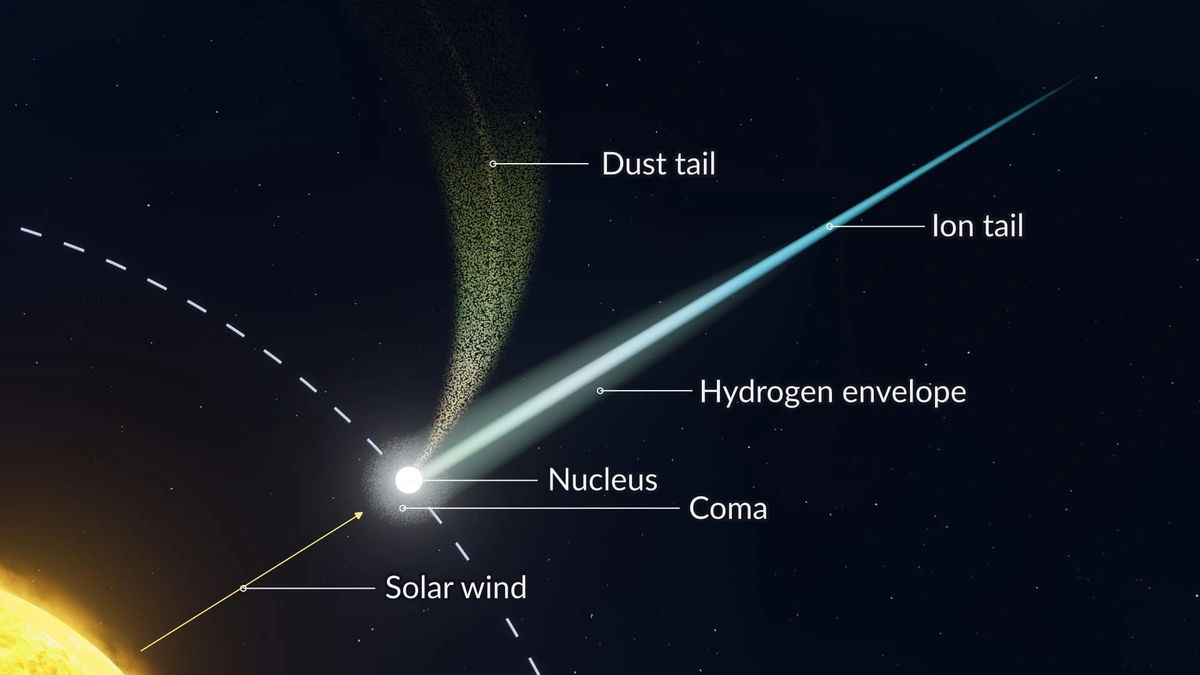
Okay, so why are we even entertaining the idea that a comet could be an alien artifact? It boils down to a few key observations that traditional explanations struggle to fully account for. These observations revolve around unusual trajectories, unexpected compositions, and, perhaps most tantalizingly, the potential presence of organic molecules – the building blocks of life.
What fascinates me is the convergence of different fields of study that’s fueling this. It’s not just astronomers; it’s astrobiologists, chemists, and even engineers who are contributing to this debate. It reminds me of the ancient Indian texts that saw the cosmos as interconnected with life itself. But unlike those texts, we now have telescopes and spectrographs. Consider ‘Oumuamua, the first interstellar object detected passing through our Solar System. Its elongated shape and unusual acceleration left scientists scratching their heads. While most believe it to be a natural object, its peculiarities fueled speculation about artificial origins. Similarly, certain comets exhibit behaviors that defy easy explanation, prompting researchers to explore more unconventional possibilities.
The Science Behind the Speculation
Let’s be honest, the idea of an alien comet sounds like something straight out of a sci-fi movie. But there’s a surprising amount of actual science that underpins the speculation. One key area of interest is the composition of comets. We know that they contain water ice, dust, and various other compounds. But some comets have been found to contain complex organic molecules, including amino acids – the very building blocks of proteins.
Now, the presence of these molecules doesn’t automatically mean that a comet’s composition is a sign of alien life. These organic compounds can also form through natural processes. However, the abundance and complexity of these molecules in some comets have led scientists to wonder if they might have originated from a more biologically active environment. As an example, consider the Philae lander’s discovery on Comet 67P/Churyumov-Gerasimenko. It detected organic molecules, including some containing carbon and nitrogen, essential for life as we know it. What intrigues me is the possibility that comets like these could have played a role in seeding life on Earth, or even other planets. Read more about alien technology here
Online Debate and the Power of Speculation
Of course, the alien comet theory isn’t just confined to scientific journals and conferences. It’s also taken on a life of its own online. Social media platforms, forums, and blogs are filled with discussions, debates, and even outright arguments about the possibility of alien involvement. While some see it as a harmless bit of fun, others worry about the spread of misinformation and pseudoscience. It’s like the ancient debates we had in India about the nature of reality, but now amplified by the internet.
What I find fascinating about this online debate is the way it highlights the power of speculation. When faced with the unknown, humans have a natural tendency to fill in the gaps with their own ideas and beliefs. This can be a positive thing, as it can lead to new discoveries and insights. But it can also be dangerous if it leads to the acceptance of unsubstantiated claims and conspiracy theories. It’s crucial to approach these discussions with a critical and discerning eye, always being willing to question our own assumptions and biases. It is important to know what is an interstellar object and what its origin is.
Why This Matters to Us in India
You might be wondering, why should we in India care about the possibility of alien comets? Well, for starters, India has a rich history of astronomical observation and scientific inquiry. From the ancient observatories of Jantar Mantar to the modern-day Indian Space Research Organisation (ISRO), we have always been fascinated by the cosmos.
But beyond that, the debate about alien comets raises fundamental questions about the nature of life, the origins of our planet, and our place in the universe. These are questions that resonate with people from all walks of life, regardless of their nationality or background. Moreover, it reminds us of the importance of scientific curiosity and the need to encourage critical thinking and open-minded inquiry. The online debate around comets also stresses the importance of fact checking before believing anything.
And let’s be honest, the idea of potentially finding evidence of extraterrestrial life is just plain exciting. It would be a game-changer for humanity, and it could have profound implications for our understanding of ourselves and our place in the cosmos. If you like reading about science check this out.
The Future of Comet Research
So, what does the future hold for comet research? Well, there are a number of exciting missions planned that could shed more light on the composition and origins of these icy bodies. For example, NASA’s Dragonfly mission will explore Saturn’s moon Titan, which has a dense atmosphere and a surface rich in organic molecules. And the European Space Agency’s Comet Interceptor mission will visit a dynamically new comet, one that has never previously entered the inner solar system.
These missions, along with ongoing ground-based observations and theoretical studies, will undoubtedly provide us with a more complete picture of comets and their role in the universe. And who knows, maybe one day we will even find definitive evidence that a comet is indeed of alien origin. But even if we don’t, the journey of discovery will be well worth it.
FAQ About Comets
What exactly is a comet anyway?
Comets are essentially icy dirtballs that orbit the Sun, leaving a trail of gas and dust behind them as they get closer.
Are comets dangerous to Earth?
While some comets have orbits that intersect with Earth’s, the chances of a major collision are thankfully very slim.
Could comets have brought water and organic molecules to Earth?
It’s a leading theory! Scientists believe comets could have played a significant role in seeding early Earth with the ingredients for life.
Will I be able to see a comet soon?
Keep an eye on astronomy news! Bright comets that are visible to the naked eye are rare, but they do appear from time to time.
Is there a difference between a comet and an asteroid?
Yes! Comets are mostly ice and dust, while asteroids are primarily rock and metal. Also, comets have that iconic tail, while asteroids usually don’t.
What are the most important organic molecules found on comets?
Scientists have found water, ammonia, methane, and other carbon-containing molecules on comets, all essential for life as we know it.
About the Author