
Apophis | NASA's Risky Asteroid Mission!
Okay, let’s be honest, when you hear about NASA snapping pictures, you probably think, “Yeah, yeah, pretty space pics.” But this isn’t just another pretty picture. This is NASA’s OSIRIS-APEX spacecraft, previously known for its daring mission to asteroid Bennu, giving us a sneak peek of its next target: the potentially hazardous asteroid Apophis . And what’s fascinating is why they’re doing it this way.
Why This Trip Matters | More Than Just Asteroid Photos
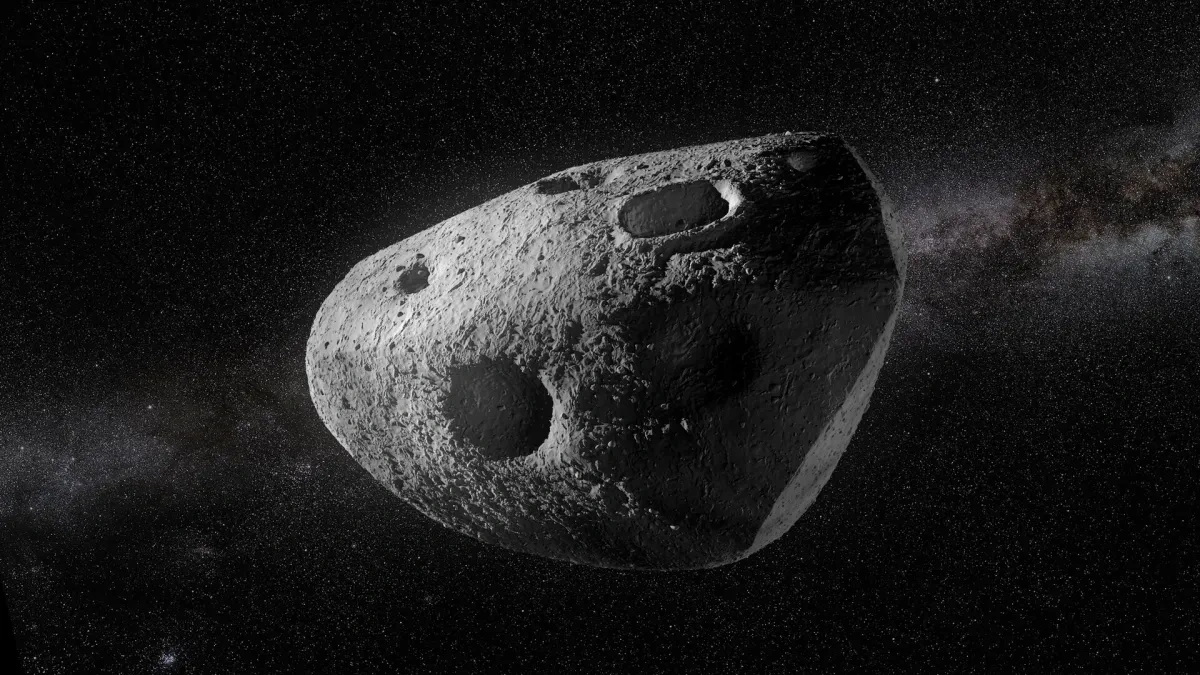
So, why is NASA so interested in this particular space rock? Apophis isn’t just any asteroid. Initial observations, back in 2004, suggested a worryingly high probability of it hitting Earth in 2029. Panic ensued – as it tends to when you hear “asteroid impact.” While further observations thankfully ruled out the 2029 impact, a close approach in 2029 and a possible impact scenario in the future still put it on the “potentially hazardous” list. That makes it worth studying a lot. It will pass within approximately 31,000 kilometers (19,000 miles) of Earth’s surface, closer than geostationary satellites.
The images taken of Earth and the Moon aren’t just for show. They’re crucial for calibrating OSIRIS-APEX’s instruments and testing its capabilities before the main event: intercepting Apophis after its close encounter with Earth in 2029. This close encounter will alter Apophis ‘s orbit and surface characteristics.
Think of it like this: it’s like watching a billiards ball swing close to another, impacting its trajectory. Orbital trajectory is a key calculation here, and NASA needs to be accurate to know how close it is going to come.
OSIRIS-APEX | A Second Life for a Spacecraft
What fascinates me is that this isn’t a brand-new mission. OSIRIS-REx, now OSIRIS-APEX, successfully completed its primary mission of collecting a sample from asteroid Bennu. But instead of retiring the spacecraft, NASA is giving it a second life, redirecting it to Apophis . This is a brilliant move. It saves time and resources, allowing scientists to leverage existing technology and expertise. It’s also a testament to the robustness of the spacecraft itself. Using this spacecraft, NASA hopes to study changes to the asteroid caused by its close encounter with Earth. This includes changes to the asteroid’s surface, orbital trajectory , rotation rate, and even its composition. The mission aims to provide valuable insights into the behavior of asteroids and improve our understanding of the potential threat they pose to our planet.
And, it demonstrates the sheer ingenuity of space exploration; Perseverance on Marsis another example.
The Science Behind the Snapshots | What Can We Learn?
Let’s get a little technical. The images of Earth and the Moon, captured by OSIRIS-APEX’s MapCam imager, aren’t just pretty pictures. They serve a critical purpose: instrument calibration. By comparing these images with existing data, scientists can fine-tune the spacecraft’s instruments, ensuring they’re operating at peak performance when they reach Apophis .
But there’s more to it than that. These images also provide valuable data about the Earth-Moon system itself. They allow scientists to study the Earth’s atmosphere, the lunar surface, and the interaction between the two. This kind of data can be used to improve our understanding of planetary formation and evolution. Moreover, such a mission gives opportunities to researchers for asteroid observation and data analysis.
What fascinates me, however, is the ability to analyze the asteroid’s chemical composition from afar.
Why You Should Care About Apophis (Even If It Doesn’t Hit Us)
Okay, so the chances of Apophis hitting us are slim. But here’s the thing: studying Apophis is about more than just preventing a potential impact. It’s about understanding the fundamental processes that shaped our solar system. Asteroids are like time capsules, preserving material from the early days of the solar system’s formation. By studying their composition and structure, we can learn about the conditions that existed when the planets were forming.
Furthermore, understanding how asteroids behave is crucial for planetary defense. If, and that’s a huge ‘if’, a truly dangerous asteroid were discovered, we would need to know how to deflect it. Missions like OSIRIS-APEX provide invaluable experience in this area. The asteroid’s chemical composition is also a major study point.
And here’s the deal: resource utilization. Asteroids are rich in valuable resources, including water, metals, and rare earth elements. In the future, asteroids could become a source of these resources, fueling space exploration and even supporting life in space. Okay, granted, that’s a long way off, but it all starts with understanding these space rocks. What’s more, OSIRIS-APEX’s journey gives more chance for asteroid observation .
What Happens After the Close Encounter? The Grand Finale
After Apophis ‘s close encounter with Earth in 2029, OSIRIS-APEX will move in for an in-depth study. The spacecraft will spend about 18 months orbiting the asteroid, mapping its surface, analyzing its composition, and measuring its mass. This data will provide invaluable insights into the asteroid’s properties and its response to the gravitational forces of Earth. And what will the effects of the sun’s radiation be?
The mission will culminate in a daring maneuver: OSIRIS-APEX will fire its thrusters to stir up the asteroid’s surface, exposing subsurface material. This will allow scientists to study the asteroid’s composition in even greater detail. It’s a risky move, but the potential rewards are enormous.
FAQ About Asteroid Apophis and OSIRIS-APEX
When will Apophis make its close approach to Earth?
Apophis will make a very close approach to Earth in 2029, passing within approximately 31,000 kilometers (19,000 miles).
Is there a chance Apophis will hit Earth?
While initial observations raised concerns, subsequent data has ruled out an impact in 2029. However, scientists are still studying the possibility of a future impact, as the 2029 close encounter will change its orbit.
What is OSIRIS-APEX going to do?
OSIRIS-APEX will study Apophis after its close encounter with Earth to observe changes in its orbit and surface characteristics. It will map the asteroid, analyze its composition, and even stir up its surface to expose subsurface material.
Why is studying asteroids important?
Studying asteroids helps us understand the formation of the solar system, assess potential threats to Earth, and potentially unlock valuable resources for future space exploration.
What is orbital trajectory and why is it important?
Orbital trajectory is the path an object in space takes around another object due to gravity. Precise calculation of an object’s trajectory is vital in order to ensure the object does not impact with another object.
What is the chemical composition of Apophis?
The asteroid is believed to be composed of silicate (rock) and nickel-iron.
So, the next time you see a headline about NASA taking pictures of asteroids, remember it is not just pretty pictures. It is about understanding our place in the universe, protecting our planet, and unlocking the secrets of the cosmos. And honestly, what’s more exciting than that?
About the Author