
Since its launch, the world has been captivated by the most powerful eye ever turned toward the heavens. But recently, a more provocative headline has dominated social media feeds and late-night forums: the james webb telescope alien armada. The idea that our billion-dollar golden mirror has caught a glimpse of a fleet of interstellar spacecraft traveling through the void is enough to send chills down anyone’s spine.
But where did this theory come from? Is there truly a james webb telescope alien armada heading our way, or are we simply seeing the ghosts of the early universe? To understand the mystery, we have to dive deep into the data, the breathtaking visuals, and the reality of how we observe the final frontier.
The Origin of the James webb telescope alien armada Theory
The internet is a breeding ground for wonder and misinformation alike. The rumors of a James webb telescope alien armada primarily surfaced after the release of several deep-field observations. In these high-resolution captures, eagle-eyed enthusiasts noticed peculiar, geometric patterns and clusters of light that didn’t seem to fit the traditional “spiral” or “elliptical” shapes of galaxies.
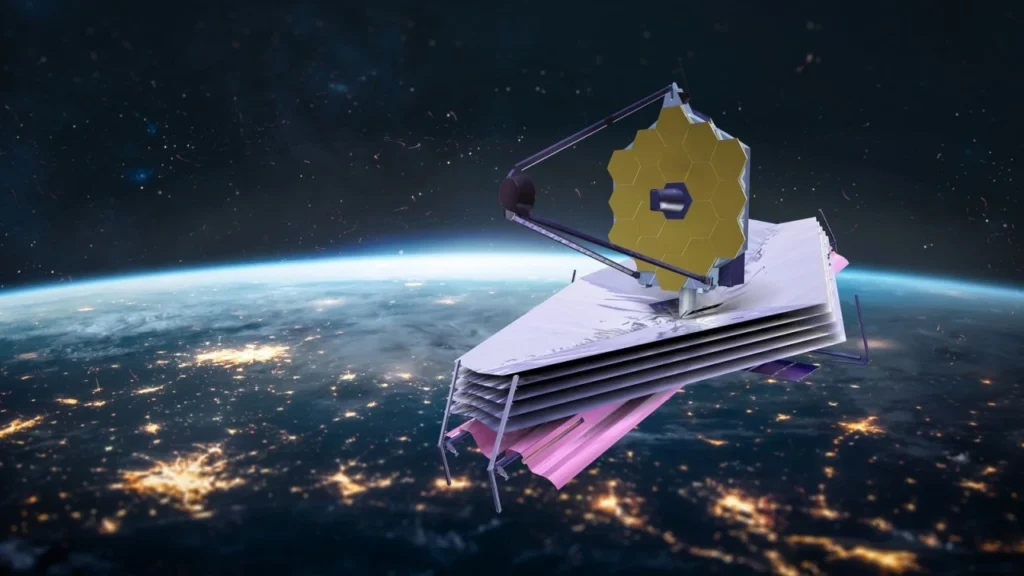
When the James Webb Telescope began sending back its first sets of data, the sheer clarity was overwhelming. Unlike its predecessor, Hubble, the James Webb Space Telescope orbit allows it to sit at the second Lagrange point (L2), nearly a million miles away from Earth. This unique vantage point provides a stable, cold environment perfect for infrared observation. However, this same sensitivity means that the James Webb Telescope picks up everything, including artifacts and reflections from interstellar objects, that the untrained eye might mistake for a structured fleet of ships.
Decoding the James webb telescope alien armada Visuals
To the average viewer, a cluster of bright, uniform dots in the middle of a dark void looks like a formation. This is exactly how the James webb telescope alien armada myth gained traction. People pointed to “anomalies” in the James Webb Telescope images that appeared too organized to be natural.
reality, these “ships” are often one of three things:
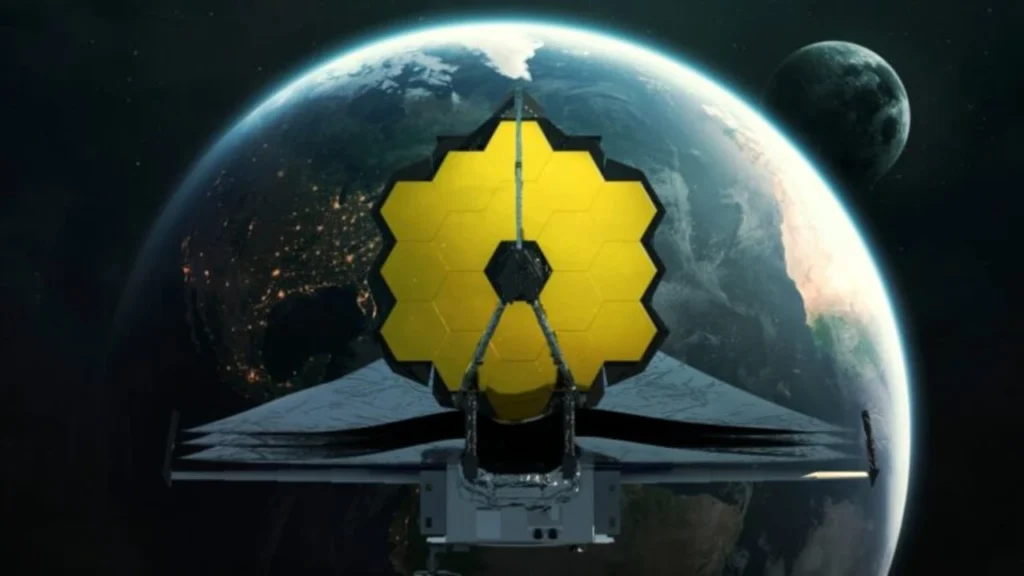
- Diffraction Spikes: Because of the hexagonal shape of the telescope’s mirrors, very bright stars create a specific eight-pointed star pattern. In certain crops of the images, these can look like structured objects.
- Gravitational Lensing: This is a phenomenon where a massive object (like a galaxy cluster) bends the light of things behind it. This can stretch distant galaxies into arcs or duplicate them, making it look like a “line” of identical ships.
- Cosmic Rays: Even in the distant James Webb Space telescope orbit, high-energy particles occasionally strike the camera’s sensors, creating bright streaks or dots that aren’t actually in space.
While the idea of a James webb telescope alien armada is exciting, the scientific community reminds us that the “armada” is usually a collection of galaxies containing billions of stars, located billions of light-years away.
Why the James webb telescope alien armada Captures Our Imagination
Humans are wired for pattern recognition. We want to find others among the stars. When we look at James Webb Telescope news, we aren’t just looking for scientific data; we are looking for a mirror to our own existence. The James webb telescope alien armada narrative persists because it represents our collective hope (and fear) that we are not alone.
The James Webb Telescope was designed specifically to look back in time. It sees the first light of the first stars. When we see a cluster of “lights” and label it an armada, we are projecting our 21st-century technology onto the ancient cosmos. However, just because this specific theory might be a misunderstanding of the data doesn’t mean the James Webb Telescope isn’t looking for life.
Real Discoveries in James Webb Telescope News
If you move past the sensationalism of a James webb telescope alien armada, the actual James Webb Telescope news is even more incredible. Instead of finding a fleet of ships, the telescope is analyzing the “breath” of distant planets.
For example, the telescope recently investigated K2-18b, an exoplanet located in the habitable zone of its star. The James Webb Telescope images and their corresponding spectrographic data suggested the presence of carbon-bearing molecules, including methane and carbon dioxide. Even more intriguing was the possible detection of dimethyl sulfide (DMS), a molecule that on Earth is produced only by life, specifically phytoplankton in marine environments. While scientists stress caution, such findings have fueled speculation across the scientific community and online discussions about planetary defenses un target, UN target scenarios, and how humanity might respond if signs of extraterrestrial life were ever confirmed.
While this isn’t a James webb telescope alien armada, it is perhaps the most significant hint of extraterrestrial life we have ever found. Finding a planet with a potential ocean is far more scientifically significant than a blurry photo of what might be a ship.
Understanding the James Webb Space Telescope Orbit and Observation Power
The reason we can even have a debate about a James webb telescope alien armada is due to the incredible engineering of the craft. The James Webb Space telescope orbit is not around the Earth, but around the Sun. It stays in line with Earth as it moves, hidden behind our planet’s shadow to stay cool.
This position allows the James Webb Telescope to observe infrared light, which is essentially heat. If a real James webb telescope alien armada were traveling through space, they would likely give off a heat signature. However, space is incredibly vast. The objects we see in the James Webb Telescope images are often so far away that their light has been traveling for 13 billion years. If those were ships, the “aliens” who built them would have existed long before the Earth was even formed.
Could JWST Actually See an Alien Armada?
If we set aside the current rumors, a fascinating question remains: Could the James Webb Telescope actually see an alien civilization?
The answer is a qualified “yes,” but it wouldn’t look like a fleet of ships. Scientists are using the James Webb Telescope to look for “technosignatures.” This includes:
- Atmospheric Pollution: If a planet has CFCs (chlorofluorocarbons), it’s a sign of an industrial civilization.
- Dyson Spheres: If an alien race built a structure around their star to harvest energy, the James Webb Telescope would detect the infrared heat leakage.
- Artificial Light: While difficult, the telescope could theoretically detect the night-side illumination of a massive urbanized planet.
So, while the James webb telescope alien armada may be a myth, the telescope is actively searching for the neighborhoods where such an armada might live.
Frequently Asked Questions (FAQ)
1. Did James Webb telescope detect aliens?
As of now, the James Webb Space Telescope has not definitively detected aliens or confirmed the existence of extraterrestrial civilizations.
2. What did James Webb telescope detect coming towards Earth?
The James Webb Space Telescope has not detected any alien fleets or physical objects moving toward Earth, as its mission is to observe ancient light from the distant corners of the universe.
3. Which country owns the James Webb telescope?
It was developed and is currently operated in partnership with the European Space Agency (ESA) and the Canadian Space Agency (CSA).
4. How much gold is in a James Webb telescope?
The James Webb Space Telescope contains roughly 48 grams of pure gold, which is approximately the weight of a standard golf ball.
5. How many galaxies are in space?
Current scientific estimates suggest there are between 200 billion and two trillion galaxies within the observable universe, ranging from dwarf clusters to massive spirals.
About the Author