
Theia's Secret | How the Moon Was REALLY Made
Ever look up at the moon and wonder where it really came from? I mean, we’ve all heard the science, but the story behind it is way more dramatic than you might think. We’re talking about a planetary smash-up involving Earth and a long-lost world named Theia . What fascinates me is not just the collision itself, but the ripple effects – how this cosmic event shaped our planet and gave us the moon we know and love. Let’s dive in, shall we? Think of this as a cosmic detective story, and we’re about to uncover some pretty explosive clues.
The Giant-Impact Hypothesis | Setting the Stage
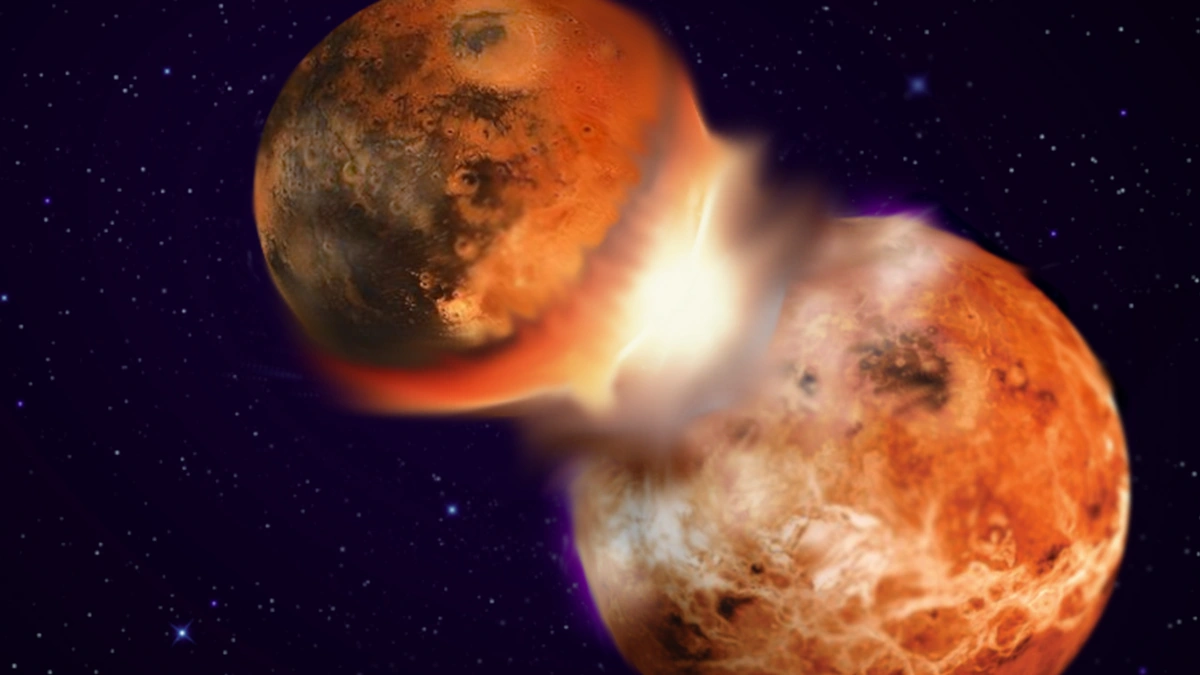
Okay, so here’s the basic idea. The most widely accepted theory for the moon’s formation is the “giant-impact hypothesis.” This suggests that early in Earth’s history, a Mars-sized object – that’s Theia – collided with our planet. Imagine that for a second. Not a gentle bump, but a full-on, planet-altering smash. The energy released would have been absolutely staggering, melting much of Earth’s surface and vaporizing a significant portion of both planets’ mantles. What’s even crazier is that this all happened about 4.5 billion years ago – pretty wild, right?
Theia’s Composition | A Missing Piece of the Puzzle
But, and here’s the thing, for years, scientists were scratching their heads about something. If the moon formed from the debris of this collision, we’d expect its composition to be a mix of both Earth and Theia . However, lunar rocks brought back by the Apollo missions showed a remarkably similar composition to Earth’s mantle. This presented a major challenge to the giant-impact hypothesis. Where was Theia ’s signature? It’s like finding a crime scene with only one person’s fingerprints – something just didn’t add up.
Scientists have been trying to find evidence of Theia’s distinct composition in lunar samples for years. The consistency of Earth and Moon samples made the scientific community rethink the giant impact hypothesis. But let’s be honest — astrophysics isn’t always straightforward.
New Evidence Emerges | A Fresh Perspective
Now, fast forward to recent years. New research is shedding light on this mystery. Advances in isotopic analysis – basically, looking at the different forms of elements in rocks – have revealed subtle differences between lunar and terrestrial rocks. These differences, though small, suggest that Theia did contribute to the moon’s formation, just not in the way we initially thought. One theory suggests that Theia ‘s impactor hit Earth at such an angle and velocity that the majority of the debris came from Earth’s mantle, with only a small fraction originating from Theia . I initially thought this was straightforward, but then I realized, that’s like trying to separate milk from coffee after you’ve already mixed it.
Another exciting development involves the discovery of titanium isotope variations in lunar samples. These variations are distinct from Earth’s and provide compelling evidence for Theia ‘s presence in the lunar material. It’s like finding a tiny piece of Theia ‘s DNA hidden within the moon’s rocks. So, it seems the mystery of Theia’s contribution to the moon’s formation is far from resolved.
Theia’s Legacy | Shaping Earth and the Moon
So, what does all this mean for us? Well, for starters, it reinforces the idea that cataclysmic events played a crucial role in shaping our solar system. The collision with Theia not only created the moon but also significantly impacted Earth’s early evolution. It likely contributed to the formation of Earth’s core and mantle and may have even played a role in the emergence of life. According toNASA, such collisions can have long lasting effects. The moon itself, stabilized Earth’s axial tilt, leading to relatively stable seasons – something we often take for granted. Without Theia ‘s impact, Earth might be a very different place today. It’s a humbling thought, isn’t it?
The implications of this theory extend beyond our understanding of the Moon’s origins. It informs our models of planetary formation throughout the galaxy. A common mistake I see people make is thinking of the solar system as a static place. But, dynamic events shaped the universe and continue to do so.
The Ongoing Search for Theia
The search for more evidence of Theia continues. Scientists are constantly refining their models and analyzing new data from lunar missions and meteorites. One of the biggest challenges is distinguishing between material from Earth and Theia , as they likely had similar compositions to begin with. As per the guidelines mentioned in the information bulletin, researchers are now focusing on trace elements and isotopes that can act as unique fingerprints. They are looking at things like tungsten isotopes, which can provide clues about the origin and evolution of planetary bodies. What fascinates me is the dedication — the sheer intellectual curiosity — that drives these scientists to keep digging deeper, literally and figuratively, into the mysteries of our cosmic origins. I’ve gone through similar research processes in my life and let me tell you, finding these insights takes patience. It’s like digging for gold, but instead of gold, you find knowledge.
Ultimately, the story of Theia is a testament to the power of scientific inquiry and the ever-evolving nature of our understanding. It reminds us that even the most familiar objects in our sky have complex and fascinating histories, shaped by violent events that occurred billions of years ago. And who knows what other secrets are waiting to be uncovered in the depths of space? Check out this article aboutcomets and astrophysics.
FAQ About Theia and the Moon’s Formation
What is the Giant-Impact Hypothesis?
It’s the leading theory that the Moon formed from debris after a collision between Earth and a Mars-sized object, Theia .
Why is it so hard to find evidence of Theia?
Earth and Theia likely had similar compositions, making it challenging to distinguish their materials in lunar samples.
What kind of evidence are scientists looking for now?
Scientists are analyzing trace elements and isotopes in lunar rocks to identify unique signatures of Theia ‘s material.
Could the Moon have formed in a different way?
While the giant-impact hypothesis is the most widely accepted, other theories exist, but they don’t explain the Moon’s characteristics as well.
How does understanding the Moon’s formation help us?
It informs our understanding of how planets form and evolve throughout the universe and the early solar system.
What are titanium isotope variations?
Variations in the ratio of different titanium isotopes. These differences are subtle but measurable and provide another line of evidence that the Moon is not made exclusively of Earth material.
About the Author