Theia | Did a Lost Planet Hit Early Earth?
Ever looked up at the moon and wondered where it came from? For centuries, its origin has been one of the biggest mysteries in space. But, what if I told you that a cataclysmic collision billions of years ago between Earth and another celestial body named Theia is the most likely explanation? It’s a wild story, let’s dive in.
The Giant-Impact Hypothesis | A Crash Course

Here’s the thing: scientists have long debated the moon’s formation. The prevailing theory, known as the Giant-Impact Hypothesis, suggests that early Earth wasn’t alone in its orbit. Another protoplanet, Theia , roughly the size of Mars, shared our cosmic neighborhood. Now, here’s where things get interesting.
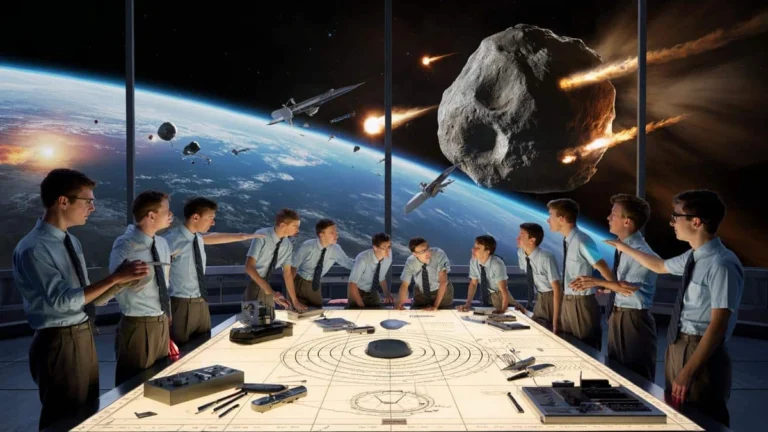
According to this hypothesis, Theia struck Eartha glancing blow about 4.5 billion years ago. The force of the impact was so immense that it ejected a massive amount of debris into space. This debris, composed of material from both Earth and Theia , eventually coalesced under its own gravity to form the moon. Crazy, right?
Why Theia? The Evidence Stacks Up
Okay, so why Theia ? What makes this hypothetical impactor so special? Well, the Giant-Impact Hypothesis isn’t just a random guess; it’s supported by a ton of evidence. One of the strongest pieces of evidence comes from analyzing the moon’s composition . Lunar rocks brought back by the Apollo missions are remarkably similar to Earth’s mantle. If the moon had formed elsewhere in the solar system, we’d expect it to have a different composition.
But, what fascinates me is the isotopic similarity. Isotopes are variants of elements with different numbers of neutrons. The fact that the moon and Earth have nearly identical isotope ratios for elements like oxygen and titanium is a huge clue. It suggests they share a common origin – a violent birth brought about by Theia’s impact.
And, it’s not just about chemical composition. The moon’s low density also supports the Giant-Impact Hypothesis. It has a much smaller iron core compared to Earth, which makes sense if it formed primarily from the Earth’s mantle and Theia’s mantle, rather than their iron cores.
New Discoveries | Unveiling Theia’s Remnants on Earth
Now, this is where things get really interesting. Recent research suggests that remnants of Theia might still be lurking deep within the Earth. Scientists have discovered two enormous blobs of dense material near the Earth’s core-mantle boundary, one beneath Africa and the other beneath the Pacific Ocean. These blobs, known as Large Low-Shear-Velocity Provinces (LLSVPs), have puzzled geologists for decades.
Some scientists believe that these LLSVPs could be fragments of Theia’s mantle that sank into the Earth after the impact. The idea is that Theia’s material was denser than Earth’s mantle, so it gradually sank down to the core-mantle boundary over billions of years. This is still a hypothesis, but the evidence is mounting. Understanding this connection helps us learn about the early solar systemand its formation.
What’s fascinating is how these blobs might influence geological processes on Earth. Some studies suggest they could be linked to the formation of volcanic hotspots and the movement of tectonic plates. If this is true, Theia’s impact didn’t just create the moon ; it continues to shape our planet today.
The Ongoing Debate and Future Research
Let’s be honest: the Giant-Impact Hypothesis isn’t without its challenges. Some scientists argue that it’s difficult to explain the moon’s near-identical isotopic composition to Earth. If the moon formed from a mixture of Earth and Theia material, we’d expect it to have a slightly different isotopic signature. So, the investigation of lunar samples is crucial to understand the entire history.
To address this, some researchers have proposed variations of the Giant-Impact Hypothesis. One idea is that the impact was even more violent than previously thought, resulting in a more thorough mixing of Earth and Theia material. Another possibility is that Theia had a similar isotopic composition to Earth to begin with. And of course, what if Theia never existed? As new research comes out and the data changes, theories have to change as well.
Future missions to the moon , such as NASA’s Artemis program, could provide even more insights into its origin. By collecting and analyzing new lunar samples, scientists hope to refine our understanding of the Giant-Impact Hypothesis and potentially uncover more evidence of Theia’s existence. The search for Theia is an on-going one and hopefully will lead to more information about Earth’s evolution.
FAQ Section
Frequently Asked Questions
What is the Giant-Impact Hypothesis?
It’s the leading theory for the moon’s origin , suggesting a collision between early Earth and a Mars-sized object named Theia .
How does the moon’s composition support the Giant-Impact Hypothesis?
The moon’s composition is very similar to Earth’s mantle, suggesting it formed from material ejected during the impact.
Could remnants of Theia still exist on Earth?
Some scientists believe that the Large Low-Shear-Velocity Provinces (LLSVPs) near the Earth’s core-mantle boundary could be fragments of Theia’s mantle.
What are the Large Low-Shear-Velocity Provinces (LLSVPs)?
They are two large, dense regions found at the base of the Earth’s mantle that some scientists think may be remnants of Theia .
Are there alternative theories to the Giant-Impact Hypothesis?
Yes, but the Giant-Impact Hypothesis remains the most widely accepted explanation for the moon’s formation.
How will future lunar missions help us understand the moon’s origin?
By collecting and analyzing new lunar samples, scientists hope to refine our understanding of the Giant-Impact Hypothesis and potentially uncover more evidence of Theia’s existence.
So, the next time you gaze at the moon , remember that it might be a cosmic souvenir from a collision that shaped the Earth we know today. It’s a reminder that our planet’s history is full of surprises, and there’s always more to discover. But, I wouldn’t want to have been around when Theia crashed into Earth. Talk about a bad day!
About the Author