Kaku's Comet Theory Confirmed?!
Okay, folks, let’s talk comets – but not just any comets. We’re diving into the weird and wonderful world of interstellar comets, specifically 3I/ATLAS, and how its behavior is giving some serious credence to predictions made by none other than Michio Kaku, the rockstar theoretical physicist. What fascinates me is not just that these icy wanderers exist, but how they’re shaking up our understanding of, well, pretty much everything. This is way beyond your garden-variety space rock; it’s about probing the very edges of our solar system and beyond.
What Exactly is Non-Gravitational Acceleration?
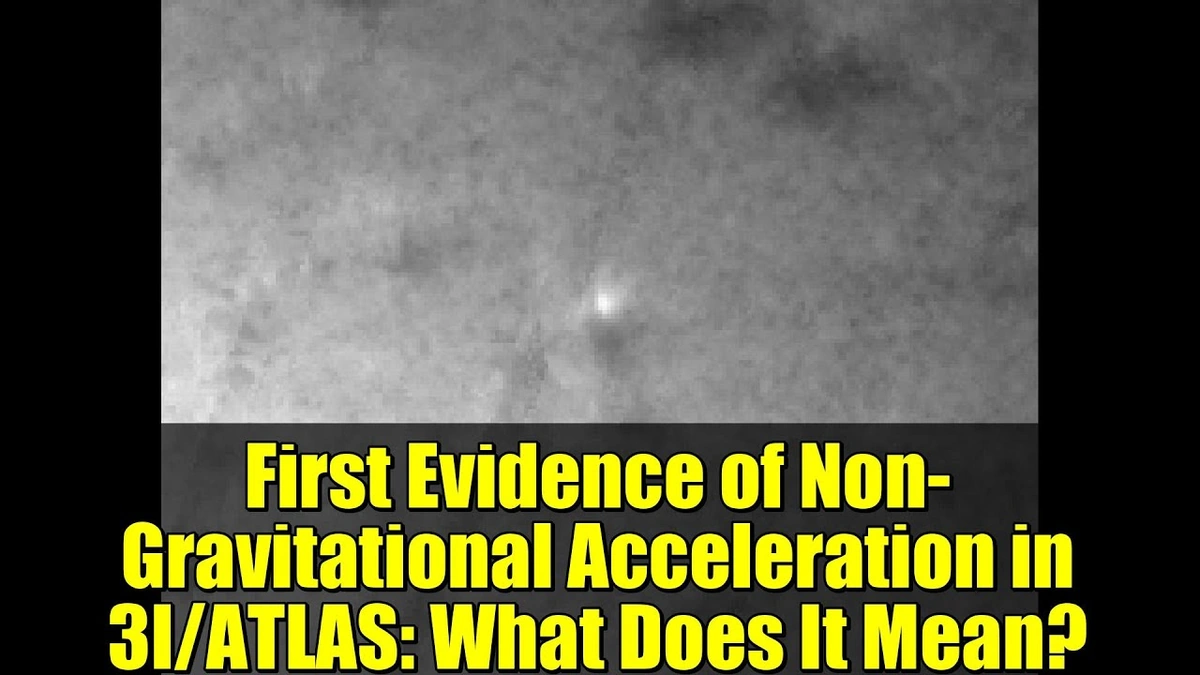
So, what are we even talking about here? ” Non-gravitational acceleration ” might sound like something out of a sci-fi movie (Kaku’s influence, perhaps?), but it’s a real, measurable phenomenon. Basically, comets aren’t just pulled around by the sun’s gravity. They also experience tiny pushes and pulls caused by the ice on their surface sublimating – turning directly into gas. This outgassing acts like little rocket boosters. Here’s the thing: the strength and direction of these ‘boosters’ can tell us a lot about the comet’s composition and structure.
Why is this important? Because it messes with our ability to predict where the comet will be in the future. Astronomers need to account for these non-gravitational forces to accurately track comets, especially those that might come close to Earth. It’s a cosmic game of pool, and these outgassing events are like unexpected nudges that change the trajectory of the ball. And with 3I/ATLAS, these nudges are proving particularly interesting, hinting at something deeper than just ordinary ice sublimation.
Kaku’s Energy Prediction and 3I/ATLAS
Now, let’s bring in Kaku. Michio Kaku has proposed ideas about how advanced civilizations might harness energy – specifically, building structures around stars to capture their energy output (think Dyson spheres, but perhaps more subtle). The connection? Some theories suggest that certain unusual cometary behaviors, including specific patterns of non-gravitational acceleration , could be explained by advanced manipulation of comets. I initially thought this was straightforward, but then I realized how speculative it sounded. Let me rephrase that for clarity: While the non-gravitational acceleration observed in 3I/ATLAS doesn’t prove Kaku’s theories, it aligns with certain predictions about what we might observe if such advanced energy manipulation were happening. Read more about interstellar objects.
Of course, the most likely explanation is still related to the comet’s composition and how it interacts with solar radiation. But the fact that the data is at least consistent with some aspects of Kaku’s predictions? That’s enough to make any space enthusiast raise an eyebrow. It’s a reminder that sometimes, the wildest theories are worth considering, especially when faced with unexpected observations. And it’s this interplay between observation and theory that drives science forward.
The Implications for Interstellar Comet Research
So, what does all this mean for the study of interstellar comets? Well, it highlights the need for more detailed observations and more sophisticated models. We need to understand the composition and structure of these comets to predict their behavior accurately. A common mistake I see people make is assuming that all comets are the same. They’re not! Each one is a unique snowflake, carrying a different story from its home star system. This is why missions that can directly analyze cometary material, like the Rosetta mission to Comet 67P/Churyumov-Gerasimenko, are so crucial. They provide the ground truth that helps us interpret the more distant observations of objects like 3I/ATLAS. But, understanding the composition of comets and their behavior gives us a lot of information about the early solar system.
And it’s not just about understanding comets themselves. The analysis of 3I/ATLAS’s non-gravitational acceleration helps us to understand more about the interstellar medium – the sparse material that fills the space between stars. These comets are messengers from other star systems, carrying information about their origins. According to the latest studies, interpreting their behavior allows us to infer the properties of the environments they came from. It’s like studying pollen to understand the flora of a distant land.
How Can We Learn More?
The one thing you absolutely must do to stay updated is to follow the ongoing research. Keep an eye on publications from organizations like NASA and the European Space Agency (ESA). But also follow the work of individual researchers and institutions that specialize in cometary studies. Websites like arXiv.org often host pre-prints of scientific papers, giving you a sneak peek at the latest findings.
And don’t be afraid to dive into the primary literature. While some scientific papers can be dense, many are accessible to a motivated reader. Focus on the introduction and conclusion sections, which often provide a good overview of the research. And remember, science is a process. New findings are constantly emerging, and our understanding of comets like 3I/ATLAS is constantly evolving. We also must monitor the trajectory of comets for potential impacts. Learn more about space research here.
FAQ About 3I/ATLAS and Non-Gravitational Acceleration
Frequently Asked Questions
What exactly causes non-gravitational acceleration in comets?
It’s caused by the sublimation of ice (turning directly into gas) on the comet’s surface, which acts like small rocket thrusters.
Does 3I/ATLAS’s behavior prove Kaku’s energy prediction?
No, but its observed unusual cometary behaviors are consistent with some aspects of his theoretical predictions, which are based on capturing energy by advanced civilizations.
Why is studying interstellar comets important?
They carry information about their home star systems and the interstellar medium, providing insights into the composition and conditions of other parts of the galaxy.
Where can I find the latest information on cometary research?
Follow NASA, ESA, and individual researchers specializing in cometary studies. Check websites like arXiv.org for pre-prints of scientific papers.
What are the future possibilities of studying comets?
By understanding the trajectory of comets, we can learn much more about the properties of comets , and possibly predict when future collisions may occur.
So, the story of 3I/ATLAS isn’t just about a comet. It’s about our endless curiosity, our willingness to entertain even the most outlandish ideas, and our persistent drive to unravel the mysteries of the universe. And who knows? Maybe, just maybe, it’s a tiny hint that we’re not alone in the cosmos. Now, wouldn’t that be something?
About the Author